By Joe Stephenson, REALTOR® | Reviewed by Financial Content Team
What is Net Effective Rent (NER)?
Net Effective Rent is the average monthly revenue a landlord receives (or a tenant pays) over a lease term after deducting the value of rent-free months and cash incentives. It reveals the true financial performance of a lease compared to the “sticker price” gross rent.
I’m someone who needs to keep track of rental property numbers, especially when helping my clients. I advise my rental property investors in this way as well. I get pretty nervous if I don’t have a clear picture of what my revenue will look like after months of renting. I really love using my free net effective rent calculator to help landlords, renters, and investors stay on top of their finances and make smarter decisions when analyzing rental property performance.
Net Effective Rent Calculator
Use this tool to find your true rental income. Enter your base rent, lease terms, and concessions below to see the bottom line.
Calculation Results
Total Gross Rent—
Total Concessions Value—
Net Effective Rent / Mo—
Effective Rent / Sq. Ft.—
Gross Rent (Face Value)
Net Effective Rent (Real Value)
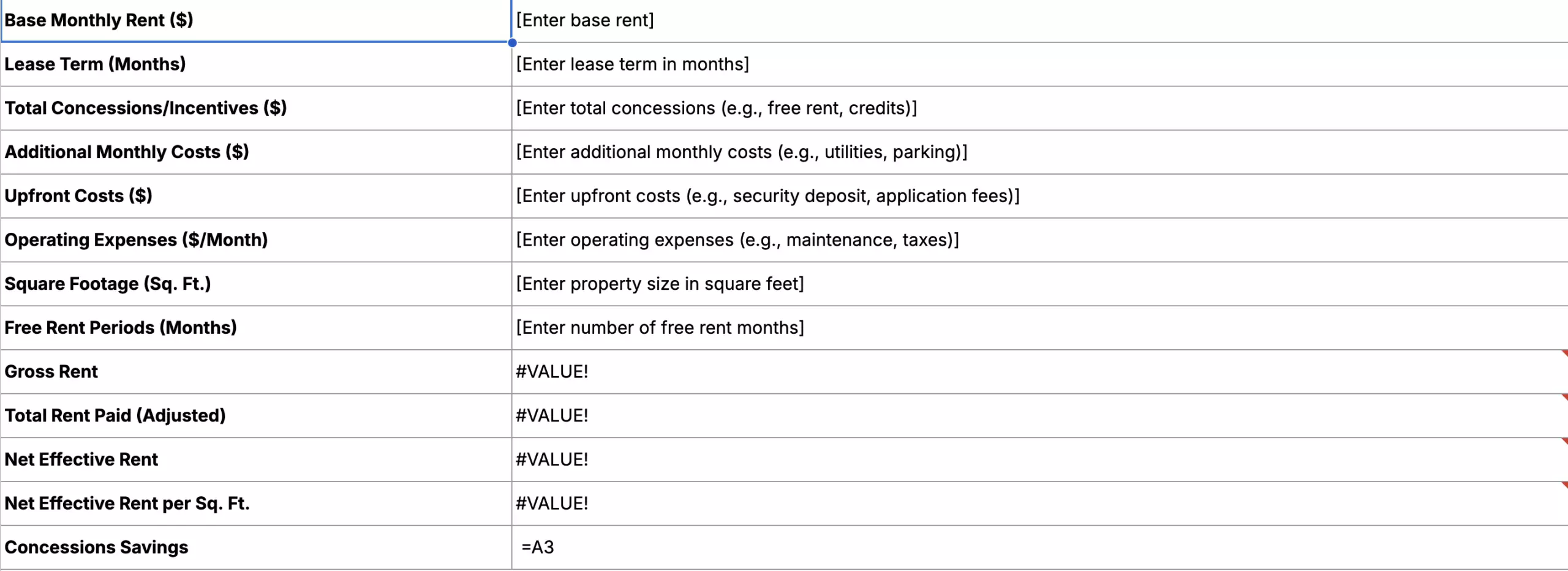
Download the Spreadsheet Templates
Need to calculate NER for a full portfolio? Download our verified spreadsheets.
How to Calculate Net Effective Rent (Step-by-Step)
The net effective rent formula adjusts the gross rent to account for lease concessions, providing a clear picture of true revenue. This is vital whether you are a landlord trying to calculate rental cash flow or a tenant comparing offers.
Formula:
(Total Base Rent – Total Concessions) ÷ Lease Term = Net Effective Rent
Factor Expenses (Optional): If analyzing landlord net income, you might subtract operating expenses here. To drill down, use our rental expenses worksheet.
Divide by Term: $22,000 ÷ 12 months = $1,833.33/month.
Real-World Case Studies
Case Study 1: Kansas City Residential Lease
Scenario: A landlord in Overland Park offers a luxury apartment for $1,800/month on a 13-month lease with one month free to attract tenants quickly.
Gross Contract Value: $23,400
Concession Value: $1,800
Net Effective Rent: $1,661/month
Insight: The landlord maintains the $1,800 “face rate” to protect property value for future appraisals but accepts a lower effective yield to reduce vacancy.
Case Study 2: Commercial Office Space (NYC)
Scenario: A business leases office space in Manhattan for $5,000/month for 3 years (36 months). The landlord offers a $10,000 Tenant Improvement (TI) allowance used for commercial lease valuation.
Case Study 3: Multi-Family “Look and Lease” (Austin, TX)
Scenario: To compete with new construction, a building offers $500 off move-in costs and 2 weeks free on a 12-month lease at $2,200/month.
Gross Contract Value: $26,400
Total Concessions: $1,600 ($500 + $1,100)
Net Effective Rent: $2,066/month
Common Mistakes & Pitfalls
Even experienced investors make errors with NER. Avoid these traps:
Ignoring Operating Costs: NER is a revenue metric. To see profit, you must subtract expenses. See our profit and loss statement template.
Assuming Linear Payments: Tenants usually pay the full gross amount for 11 months and $0 for 1 month. If you budget for the average NER amount every month, you may face a cash crunch in the free month.
Overvaluing Face Rent: Banks and appraisers often look at the effective rent, not just the face rent, when valuing commercial properties.
Net Effective Rent in the Kansas City Market
In markets like Kansas City, NER is a vital metric. While base rents may appear stable, landlords often use concessions (like “look and lease” specials) to compete without lowering the advertised price. Understanding NER helps you monitor rental profits and losses accurately amidst these fluctuations. If you are looking to expand your portfolio, check our guide on how to invest in Kansas City real estate or use our real estate cash flow tool.
Video Explanation
“Net effective rent is one of the most important numbers in commercial real estate… This calculation is very important as it takes into account the concessions that a landlord would offer to a tenant.”
– Commercial Real Estate Expert (via Video)
Read Video Transcript
Introduction
0:00
Net effective rent is one of the most important numbers in commercial real estate, and in
0:03
this video I’m going to make sure you fully understand what it is and how to calculate
0:07
it.
0:08
I’m also giving you a free calculator you can use to quickly calculate the NER and I’ll
0:11
also go through how to use it in this video. If you’re already comfortable with the differences
0:15
between net rent and operating costs, then skip this next part and jump forward to that
0:19
section.
0:20
Let’s first do a refresher on how commercial rents are calculated. This is an important
0:24
step as it plays a crucial part in calculating the NER.
Net Rent vs Gross Rent
0:28
The majority of commercial properties have two quoted rates.
0:31
The first rate you’ll see is called either the base rent or the net rent, and it will
0:35
likely be quoted as a cost per square foot per annum.
0:39
So quick example, if a property is 10,000 square feet, and the net rental rate is $10.00
0:43
per square foot, then the net rent will be calculated as follows:
0:47
10,000 square feet * $10.00 per square foot = $100,000 in yearly rent. If you want to
0:53
get the monthly amount, simply divide this by 12.
0:57
Now in addition to the base rent, tenants will be responsible for their proportionate
1:00
share of the operating costs of the building. For industrial properties, this typically
1:04
includes property taxes, building insurance, common area maintenance and management fees.
1:09
Most industrial properties have separate utilities paid for directly by the tenant, but for office
1:13
or retail properties, some or all the utilities might also be included in this prorated share.
1:18
You might already have a solid understanding of how this works, but I want to make sure
1:21
this really sinks in.
1:23
Let’s say there’s a 40,000 square foot building which is broken down into four 10,000 square
Operating Costs
1:28
foot bills. Let’s say the owner or property manager estimates the following expenses for
1:32
the upcoming year.
1:34
Property taxes: $100,000 Building insurance: $10,000
1:39
Common area maintenance: $25,000 Property Management Fees: $25,000
1:45
So the total estimated operating costs will equal $160,000.
1:50
Since each tenant occupies 25% of the building, they will be responsible for 25% of the costs.
1:56
So if we multiply $160,000 by .25, each tenant’s contribution will be $40,000. If we divide
2:03
this number by their size of 10,000 square feet, the operating costs, which is sometimes
2:07
called additional rent, will be $4.00 per square foot.
2:12
Adding base rent and the operating costs is often referred to as gross rent, which I’ll
2:16
touch on more when we get to the calculator.
2:19
One more important note, these numbers are estimates based on what the owner or property
2:23
manager expects those costs to be over the upcoming year, but once all the bills are
2:27
reconciled it may result in a shortage or an overage in the amount collected. If this
2:33
is the case, the tenant will be invoiced for the balance or receive a refund.
2:37
If there is one mistake I see new brokers or companies make more than others it’s not
2:43
fully understanding how this process works.
Net Effective Rent
2:45
We can now move onto to talk about net effective rent, or NER. This calculation is very important
2:50
as it takes into account the concessions that a landlord would offer to a tenant. This could
2:55
include free base rent, free gross rent, which again is the base rent and the operating costs,
3:00
and it could also include any tenant improvement allowances. A landlord may also want to include
3:04
any leasing commissions or other financial incentives offered to the tenant, such as
3:08
paying for moving costs.
NER calculator
3:11
Taking this all into account, let’s jump over to a spreadsheet which you can access in the
3:14
description below. I’ve actually added it
6:02
to a workbook I did another video on which includes an industrial property checklist,
6:06
rent roll and mortgage calculator.
6:08
I’m planning to continuously add to this workbook too as I genuinely want to provide as much
6:12
value as I can with this channel.
6:14
Thanks for watching, catch you in the next video!
Frequently Asked Questions
What is the difference between Gross Rent and Net Effective Rent?
Gross rent is the “sticker price” listed on the lease. Net Effective Rent is the mathematical average of what is actually paid after subtracting free months and cash incentives.
When is Net Effective Rent misleading?
NER can be misleading for cash flow planning because tenants usually pay the full gross amount in non-free months. Budgeting based on the average can lead to cash flow gaps during the rent-free months.
Does NER include utilities and operating expenses?
Strictly speaking, NER refers to base rent revenue. However, for a landlord calculating Net Operating Income (NOI), you must subtract operating expenses. Our calculator allows you to input these to see a fully burdened number.
How do I track lease renewals?
Effective rent often changes upon renewal as concessions expire. Use a lease tracker spreadsheet to manage these dates and financial shifts.
Want to Maximize Your Rental Portfolio?
Stop guessing with your numbers. Get a custom NER analysis for your property portfolio today.
What’s New in Version 2.1: Added animated visual chart, print-to-PDF support, updated Kansas City market data, and expanded commercial case studies. Last Updated: May 25, 2025
Joseph E. Stephenson, REALTOR®
License #00054082 | Kansas & Missouri | Affiliated with Welch & Company
Joseph E. Stephenson is a licensed real estate professional helping clients buy houses in Kansas City and build wealth through property. He creates tools to help investors calculate net effective rent and manage portfolios.